




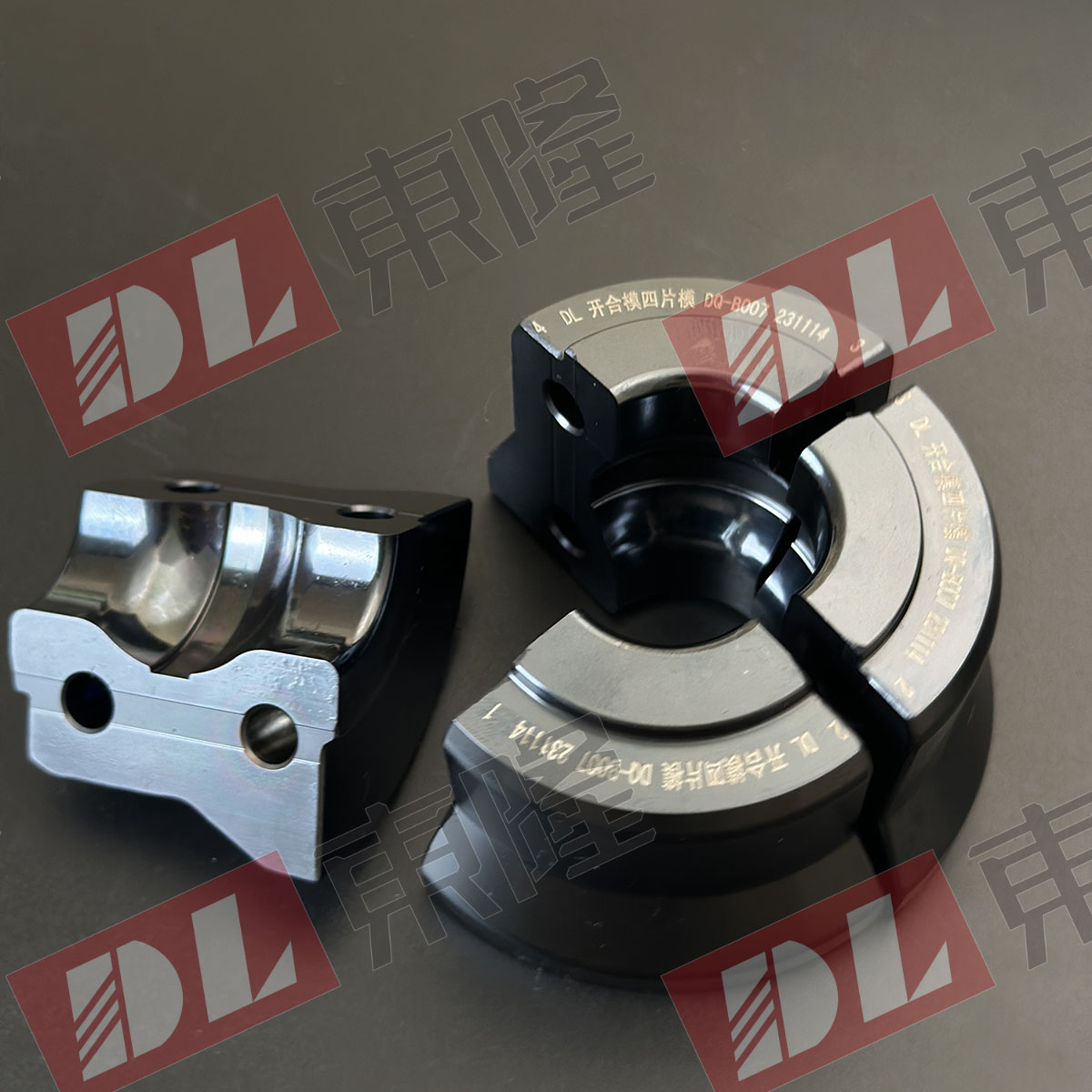
A Four-Segment Split Die is a specialized tooling solution consisting of four separate die segments designed to work together during forming or shaping operations. Depending on the tooling design, this segmented structure can help improve workpiece access, facilitate demolding, and accommodate complex component geometries. It is used in applications where a conventional one-piece die may not provide the required forming or release characteristics.
As a precision mold and die manufacturer, Donglong Mould provides customized tooling solutions for industrial manufacturing applications. Our approach focuses on tooling structure, material selection, machining accuracy, and application requirements to help customers find a suitable four-segment split die for their production processes.
What Is a Four-Segment Split Die?
A Four-Segment Split Die is a type of segmented die composed of four individual die sections that fit together to form a complete working cavity. Depending on the application, the segments may open and close radially or follow another specified movement mechanism.
Compared with a conventional solid die, a four-piece split die can offer greater flexibility when handling components with complex profiles, undercuts, or other features that make direct removal difficult. The actual advantages depend on the die construction, opening mechanism, and forming process.
Four-segment split dies can be designed for specific industrial tooling requirements, including selected forming, clamping, and shaping applications. Before selecting a split die, manufacturers should evaluate the workpiece geometry, required tolerances, operating loads, and production equipment.
Key Features of Four-Segment Split Dies
Four-Piece Segmented Structure
The defining feature of a Four-Segment Split Die is its four-part construction. Each segment forms part of the overall working cavity, and the four sections must align accurately to achieve the intended geometry.
Proper segment design and alignment are essential for maintaining dimensional consistency and reducing mismatch between the die sections.
Flexible Opening and Release
Depending on the tooling mechanism, a segmented split die can separate from the formed component more easily than a one-piece die. This can be particularly useful for applications involving complex profiles or components that are difficult to release from a closed cavity.
The opening mechanism should be selected according to the workpiece shape, production cycle, and machine configuration.
Precision Machining
A precision split die requires accurate machining of each segment and careful control of the assembled cavity. Dimensional deviations, alignment errors, or uneven contact between segments can affect forming quality and tooling performance.
Appropriate machining and inspection procedures help ensure that the assembled die meets the specified dimensional requirements.
Wear Resistance and Durability
Die material selection has a direct impact on service life, wear resistance, and performance under operating loads. Depending on the application, suitable tool steels or other engineering materials may be considered.
Material selection should account for workpiece properties, forming pressure, friction, operating conditions, and expected production volume.
Customized Tooling Design
A custom split die can be developed according to component drawings, cavity dimensions, equipment specifications, and manufacturing requirements. The number of segments, opening direction, locking structure, and material specifications should be determined by the actual application rather than a standard configuration.
Four-Segment Split Die vs. Conventional Solid Die
The choice between a Four-Segment Split Die and a conventional solid die depends on the component geometry and production process.
| Comparison | Four-Segment Split Die | Conventional Solid Die |
|---|---|---|
| Structure | Four separate die segments | One main die body |
| Die opening | Designed for segmented separation | Usually relies on the available release method |
| Complex geometries | May be suitable for difficult-to-release profiles | May be limited by cavity geometry |
| Manufacturing | Requires accurate machining and alignment of multiple segments | Focuses on the accuracy of one-piece tooling |
| Maintenance | Individual segments may be serviceable depending on design | Repair or replacement depends on die construction |
| Application | Specialized forming or shaping requirements | A wide range of conventional forming applications |
The best solution depends on the product design, tooling mechanism, machine capability, and required production efficiency. A four-segment structure is not automatically better for every application.
Applications of Four-Segment Split Dies
Four-segment split dies can be used in specialized industrial tooling applications where segmented construction offers a practical advantage. Potential applications depend on the specific die design and manufacturing process.
Precision Forming
For selected metal forming operations, a segmented die can help accommodate complex component profiles. The die cavity and opening mechanism must be designed to withstand the expected loads and maintain the required geometry.
Components with Complex Profiles
Certain components have external shapes or geometric features that make removal from a conventional die difficult. A split die may provide an alternative by allowing the tooling sections to separate during release.
Customized Industrial Tooling
Manufacturers may require non-standard dies for specialized components, dedicated equipment, or unique production conditions. Custom Four-Segment Split Dies can be evaluated according to drawings and application-specific requirements.
For Cold Heading and cold forging applications, it is important to confirm whether the four-segment design is compatible with the forming process, tooling loads, and machine structure before selecting the die.
How to Choose the Right Four-Segment Split Die
Choosing a suitable Four-Segment Split Die requires careful consideration of the following factors.
Workpiece geometry: Provide detailed drawings, dimensions, and information about any complex profiles or undercuts.
Die material: Select a material based on wear resistance, compressive strength, operating conditions, and expected service life.
Segment alignment: Confirm the required tolerances for the individual segments and the assembled cavity.
Opening mechanism: Evaluate how the segments move, how the die is locked during operation, and how the workpiece is released.
Machine compatibility: Consider installation dimensions, operating loads, movement requirements, and the available space within the equipment.
Quality inspection: Define the critical dimensions, acceptable tolerances, and inspection requirements before production begins.
Sharing these details with the die manufacturer helps establish a suitable tooling design and reduces uncertainty during development.
Custom Four-Segment Split Die Manufacturer
Donglong Mould provides customized mold and die manufacturing solutions for industrial customers. We understand that specialized tooling requires more than accurate machining; the die structure, material properties, component geometry, and operating conditions must work together.
For a custom Four-Segment Split Die, customers can provide product drawings, material requirements, target dimensions, machine specifications, and expected production volume. These details help determine the appropriate segmented structure and manufacturing requirements.
Our tooling development approach emphasizes application-specific design, material suitability, machining accuracy, and dimensional inspection. Whether you are sourcing a custom split die or evaluating a segmented die for a specialized production process, clear technical communication is essential to achieving reliable results.
Contact Donglong Mould to discuss your custom split die requirements and explore a tooling solution tailored to your application.
Frequently Asked Questions
What is a Four-Segment Split Die used for?
A Four-Segment Split Die is used in applications where a die composed of four separate sections offers advantages for forming, shaping, clamping, or releasing a workpiece. Its exact function depends on the tooling design and manufacturing process.
What is the difference between a split die and a segmented die?
A split die generally refers to a die that separates into multiple sections. A segmented die emphasizes its construction from individual segments. The terms can overlap, and their precise meaning depends on the industry and tooling design.
Can a Four-Segment Split Die be customized?
Yes. A custom Four-Segment Split Die can be designed around the component geometry, required tolerances, machine configuration, material requirements, and intended production process.
Which materials are suitable for a precision split die?
Tool steels and other engineering materials may be considered depending on the application. The final choice should reflect the operating loads, wear conditions, workpiece material, and required service life.
How can split die accuracy be maintained?
Accuracy depends on precision machining, dimensional inspection, proper segment alignment, and stable assembly. Regular inspection and maintenance can also help identify wear or alignment changes before they affect product quality.